


The Cuttlefish
“I need one of these, Simon"
Torren and I have been playing around with short boards hidden inside longer outlines for some time now. The Calypte and the LBOH are both good examples of that thinking.
The idea is to hold onto the rail line and some of the characteristics of a longer midlength, then cut away the nose, the tail, or sometimes both. What remains looks small, but the important parts of the longer board are still there.

Image: needessentials
The Cuttlefish began when Torren borrowed a board from his mate Raf. It was a bodyboard-inspired design shaped by my dear friend Paul Hutchinson of VOUCH and North Coast Surfboards.
Torren first rode it in the beach breaks around home and came back with nothing but good things to say. He could not get over how easily it caught waves, or how manoeuvrable it became once it was up and running along the face.
“I need one of these, Simon,” he said.
So, with a few reference points in mind, I went into the shaping bay to make my own version.
A longer history
These shapes are not new, and I did not want to pretend they were.
Shapers including Tom Wegener and Matt Calvani at Bing Surfboards have explored similar bodyboard-inspired ideas for years. Bing’s Speed Square, developed by Calvani with Chris Del Moro, drew from Del Moro’s childhood memories of riding a Mach 77 boogie board. Belly through the nose, a fast transition into harder tail rails, deep concave and small twin keels turned the idea into a very short surfboard built for speed, glide and a loose feeling underfoot.
There is also an obvious connection to the Mini Simmons. Those boards came from Bob Simmons’ early planing-hull thinking: short, wide, full of foam, with flat rocker, straighter rails and broad tails. Simple ingredients that create speed quickly and make weak waves far more interesting.
The Cuttlefish sits somewhere in that family, but it needed to work in Torren’s world.
The first one
So I shaped him one.
Torren rode it around home in Byron, then took it back down to Tasmania. Ishka sent me a few clips from the beach breaks there, and I was pleasantly surprised by how well the board carried its speed and flow through small, weaker waves.
Then Torren sent me some iPhone footage from a bigger, colder swell down south.
That was the point when I realised just how well the board worked.
He was drawing long, arcing turns and holding high lines across proper swell lines on a board only 4’6” long. It did not look nervous or limited. It looked fast, settled and completely at home.
Like shaping any surfboard, there are certain design elements that need to be right if the board is going to interact with the water properly. When the board is this short, every one of those elements becomes more important.
The straight edges create usable rail line. The foam and full rails support the surfer. The width and planing area help the board catch waves and carry speed. The fins give it enough control without taking away the free, almost finless feeling that makes the design so interesting.
There is nowhere for a mistake to hide in such small dimensions.
The Name

It was only after the first board had been made that Torren reminded me of a photo he had sent earlier in the year.
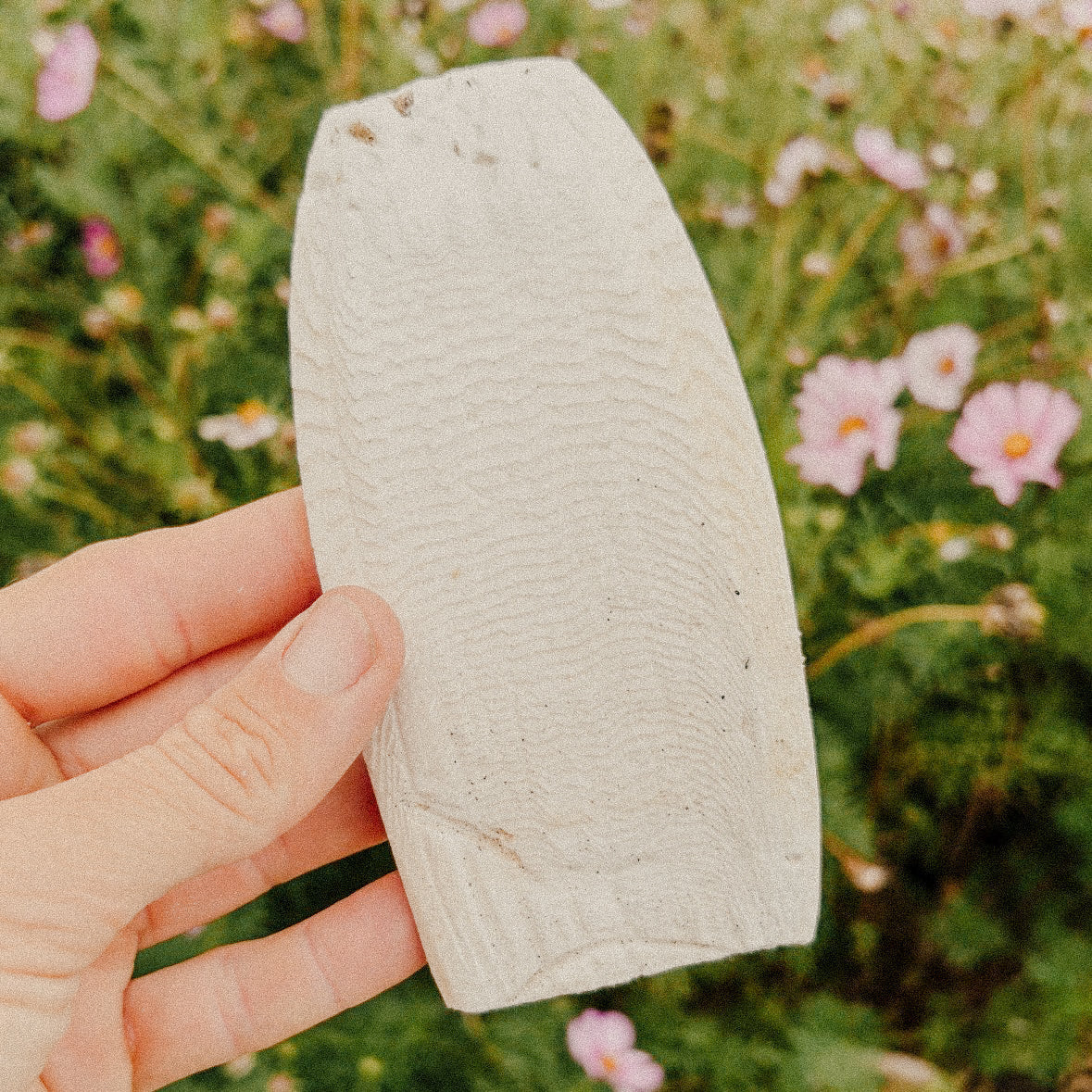
It was a cuttlefish bone he had found and shaped down into the outline of a surfboard.
The strange part was how closely it matched the board I had just shaped for him. The outline, the proportions and the clipped ends were almost exactly there.
So the board became the Cuttlefish.
That is where the story ends for now. The board is still in development, and version two is coming through the glassing room as we speak.
You are all caught up.
Watch Unconventional Craft
Our friends at needessentials recently put together a clip from a Southern Ocean swell, with Torren Martyn, Laurie Towner, Hahnee Chelkowski and Surfrider Foundation’s Drew McPherson taking a mix of unconventional boards into some very real winter conditions.
Torren rode the experimental 4’6” Cuttlefish twin fin. Laurie explored asymmetrical designs, Hahnee rode a longer board she shaped herself, and Drew surfed a Simon Jones Designs Remote Location twin fin on his backhand.
It is a good look at the Cuttlefish in serious waves, and at what can happen when surfers and shapers leave a little room for strange ideas.
Music: “Which Way to Go” by Eddy Current Suppression Ring
Produced by: needessentials
Filmed by: Tyge Landa and Joseph Elijah Daniel
Edited by: Harry Dott
Read more

In the Land of SharpEyes, There Are Three Au Go Go’s
Since Dad began shaping boards, the numbers have always been small and the aim has always been to make them as well as we possibly can. Having a hand on every board has been a big part of that. No ...
Read more
Handcrafted since 1983
Over 40 years of shaping experience, built by surfers for surfers

Proven in the water
Ridden by world-class surfers in all conditions around the globe

Small Team, Personal Service
Talk directly with board builders, no middlemen. Family owned and operated

Global Shipping
Get a Simon Jones board delivered anywhere, no matter where you surf